
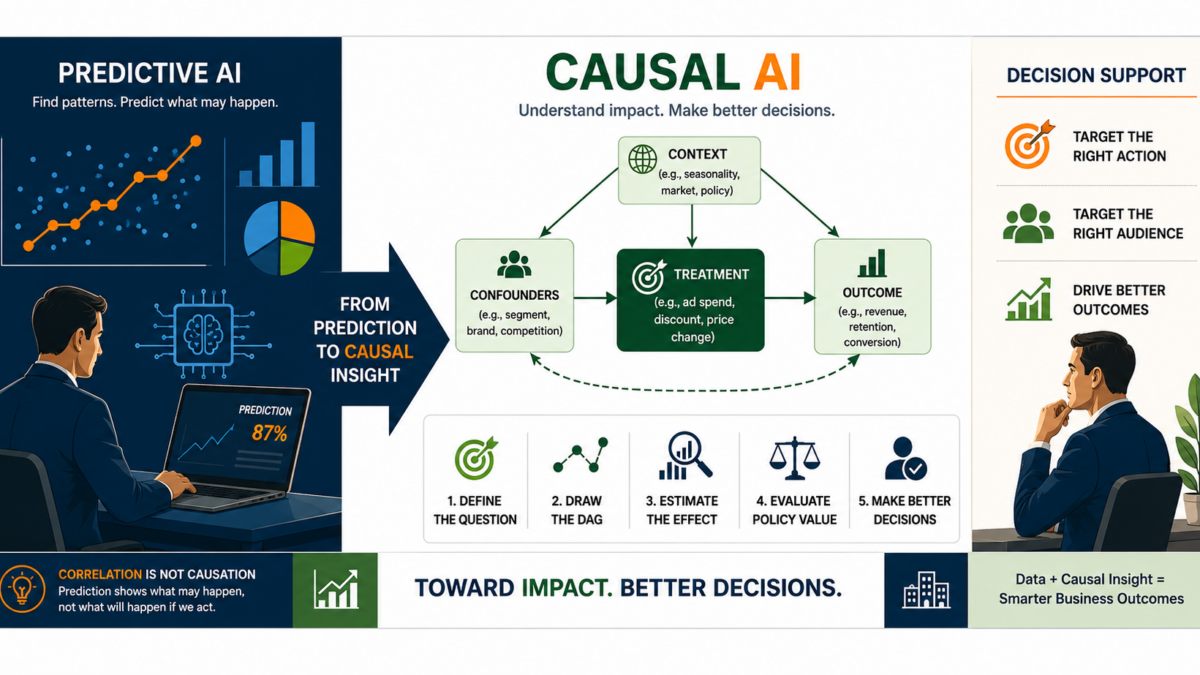
Most organizations already use AI to predict what might happen next, such as future sales, customer churn, or loan default risk. These predictions are useful, but business leaders often need a different answer:
What action should we take to improve the outcome?
Causal AI helps answer that question. Instead of only finding patterns in historical data, it estimates the likely impact of specific decisions. For example, it can estimate how revenue may change if advertising spend increases, how retention may improve if support issues are resolved faster, or how risk may change after updating an approval policy.
Causal AI is useful because it connects analytics to action. It helps organizations decide what to do, for whom, and with what expected impact.
| Question Type | Question | Business Use |
|---|---|---|
| Prediction | What is likely to happen? | Forecast sales, churn, demand, or risk. |
| Causal inference | What will happen if we take an action? | Estimate the effect of a discount, campaign, price change, or process change. |
| Counterfactual reasoning | What would have happened if we had acted differently? | Compare decisions before deploying them. |
| Personalization | Who benefits most from the action? | Target interventions to the customers, regions, products, or operations where they create value. |
1. Why Prediction Alone Is Not Enough for Business Decisions
Predictive AI is designed to forecast outcomes. It can estimate future sales, identify customers who are likely to leave, or predict the risk of loan default.
The limitation is that prediction does not explain how outcomes may change when a business takes action. A model may predict that a customer is likely to leave, but it cannot automatically tell whether a discount, better support, or a loyalty program would actually prevent that customer from leaving.
The key difference is simple:
- Predictive AI asks: What is likely to happen?
- Causal AI asks: What will happen if we take a specific action?
Organizations constantly make decisions: adjusting prices, increasing marketing budgets, changing approval policies, prioritizing suppliers, and redesigning service processes. These decisions require more than forecasts. They require an estimate of impact.
| Business Question | Predictive AI Output | Causal AI Output |
|---|---|---|
| Will this customer leave? | Probability of leaving | Which action is most likely to retain the customer |
| Will revenue increase next month? | Revenue forecast | Which action is most likely to increase revenue |
| Which marketing campaign performs best? | Correlation with revenue | Incremental revenue caused by the campaign |
| Which supplier is risky? | Supplier risk score | Impact of switching, diversifying, or renegotiating suppliers |
In short: predictive AI helps organizations understand what may happen. Causal AI helps them understand what they can do to influence the outcome.
2. Core Concepts in Practical Situation
2.1 Correlation vs. Causation
A correlation means two things move together. A causal relationship means one thing directly influences another.
This difference matters because business decisions should be based on causes, not just patterns. For example, higher advertising spend may be associated with higher sales. However, sales may actually be driven by seasonality. If that is true, increasing advertising may not create the expected lift.
| Concept | Meaning | Example |
|---|---|---|
| Correlation | Two things change together | Sales increase when advertising increases. |
| Causation | One thing directly affects another | Increasing advertising generates additional sales. |
| Counterfactual | What if we had done something differently? | Would the customer have stayed if support had responded faster? |
2.2 Treatment, Outcome, and Confounders
Most causal analysis starts with three ideas:
- Treatment: the action being evaluated.
- Outcome: the result being measured.
- Confounder: a factor that influences both the action and the result.
Example: Who Should Receive Discounts?
Suppose a company wants to increase sales by offering discounts. A common business question is:
Should discounts be offered to loyal customers, new customers, both groups, or neither?
| Causal Element | In the Discount Example |
|---|---|
| Treatment | Offering a discount |
| Outcome | Customer purchase |
| Confounder | Customer loyalty |
Customer loyalty can influence both who receives a discount and who makes a purchase:
Customer Loyalty -> Discount
Customer Loyalty -> Purchase
Discount -> Purchase
What Predictive Analysis Sees
A predictive model may find that customers who received discounts purchased more products. The business might conclude: “Customers who receive discounts buy more, so discounts work”.
That observation is useful, but it does not prove that the discount caused the purchase.
Why the Confounder Matters
Many customers who receive discounts may already be loyal. Loyal customers are usually more likely to purchase even without a discount. If customer loyalty is ignored, it becomes difficult to separate purchases caused by the discount from purchases that would have happened anyway.
What Causal Analysis Asks
Causal analysis asks a more precise question:
How much does the discount itself increase purchases?
After accounting for customer loyalty, the analysis may show that loyal customers respond moderately, new customers respond strongly, and some groups show little response. This helps the business design a better promotion strategy without assuming that one rule works for everyone.
Key takeaway: a confounder is a factor that affects both the treatment and the outcome. Causal AI tries to separate the effect of the action from the influence of those other factors.
Causal Graphs (DAGs)
A Directed Acyclic Graph (DAG) is a visual representation of cause-and-effect relationships. Instead of describing relationships only in text, a DAG shows how factors influence one another.
DAGs help identify confounders and determine which variables should be considered when estimating a causal effect. Using the discount example, the relationships can be represented as the following DAG:
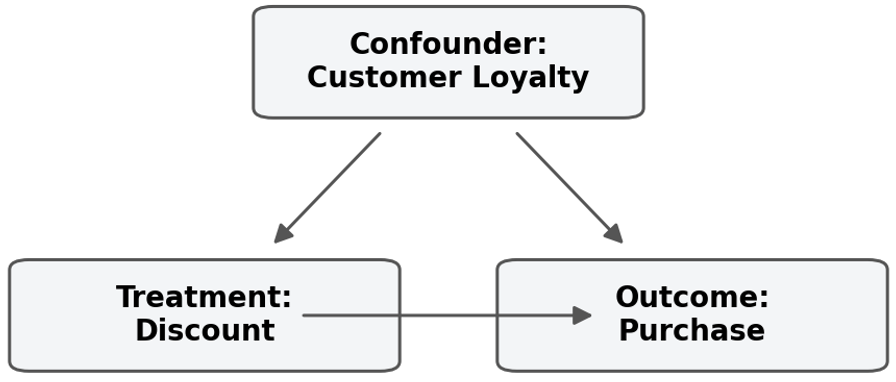
The DAG shows that customer loyalty influences both the discount decision and the purchase outcome. This makes customer loyalty a confounder that must be considered when estimating the true effect of discounts.
DAGs help answer practical questions:
- Which variables should be controlled for?
- Which variables should not be controlled for?
- Can the effect of the treatment be estimated reliably?
In practice, a DAG serves as a blueprint for causal analysis by making cause-and-effect assumptions explicit before modeling begins.
2.4 ATE, CATE, and Policy Value
After identifying the treatment, outcome, and confounders, the next step is measuring the impact of the intervention.
For the discount example, the business may ask: “How much do discounts increase purchases?”
The answer is often more nuanced than one number because different customer groups may respond differently.
Average Treatment Effect (ATE)
The Average Treatment Effect measures the average impact of an intervention across the full population.
| Scenario | Purchase Rate |
|---|---|
| No discount | 20% |
| Discount offered | 20% |
ATE = 25% – 20% = 5 percentage points
This means the discount increases purchases by an average of 5 percentage points across all customers.
Conditional Average Treatment Effect (CATE)
CATE measures the effect for a specific subgroup. This helps answer who benefits most from the intervention.
| Customer Group | Increase in Purchases |
|---|---|
| New customers | +10% |
| Loyal customers | +3% |
| Occasional customers | +1% |
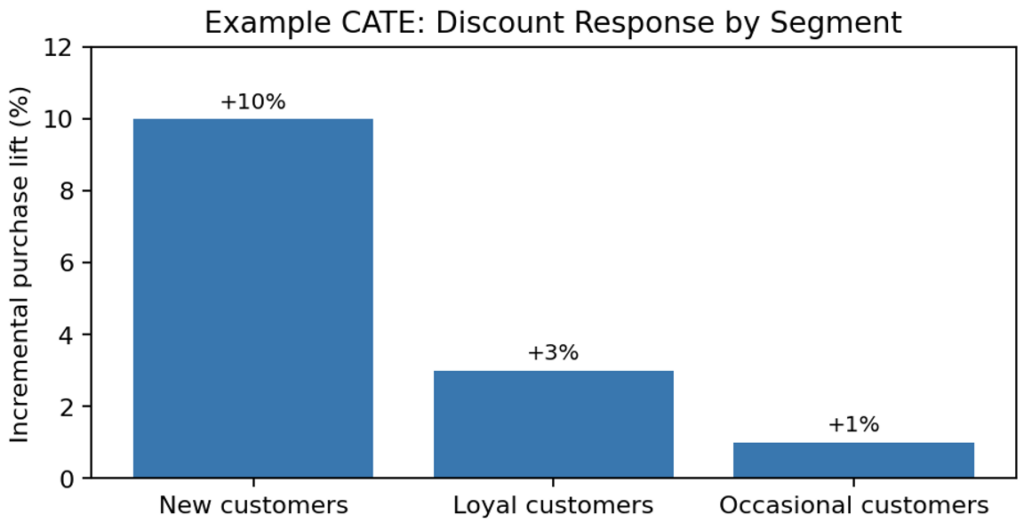
In this example, discounts have the greatest incremental impact on new customers. That does not mean loyal customers should never receive discounts; it means the measured business impact differs by group.
Policy Value
Policy value estimates the expected outcome of a decision strategy. It helps compare alternatives before deployment.
| Strategy | Expected Purchase Rate |
|---|---|
| Discount everyone | 25% |
| Discount high-response customers | 30% |
Policy Value answers: Which decision rule should we implement?
| Concept | Meaning | Business Question |
|---|---|---|
| ATE | Average effect across all customers | Does the intervention work overall? |
| CATE | Effect for a specific group | Which customers benefit most? |
| Policy Value | Expected outcome of a decision strategy | Which action should we take? |
Key takeaway: ATE shows whether an intervention works on average. CATE shows where it works best. Policy Value helps choose the best decision strategy.
End-to-End Causal AI Architecture for Decision Support
Understanding causal concepts is only the first step. To create business value, organizations need a repeatable architecture that transforms data into decision support.
A production-grade Causal AI system combines data, causal reasoning, effect estimation, decision simulation, deployment, monitoring, and governance.
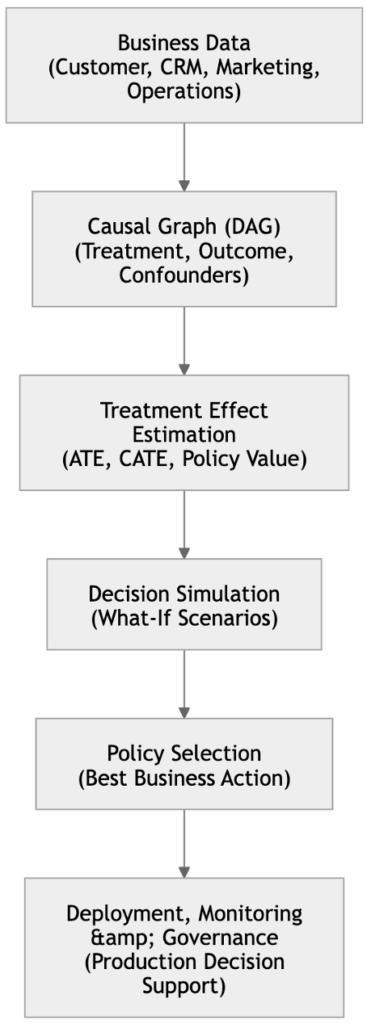
3.1 Collect Business Data
Gather data related to the decision, the treatment, the outcome, and possible confounders.
- Customer transactions and purchase history
- CRM, loyalty, and campaign data
- Pricing and promotion history
- Customer support interactions
- Operational events and external business factors
For a discount use case, relevant data may include purchases, discount exposure, loyalty status, demographics, campaign participation, and time period.
3.2 Define the Causal Graph
Define the assumed cause-and-effect relationships before modeling. The DAG documents the treatment, outcome, confounders, and variables that should or should not be controlled for.
Customer Loyalty -> Discount
Customer Loyalty -> Purchase
Discount -> Purchase
This step is important because causal analysis depends on assumptions about how the business process works. Those assumptions should be reviewed with domain experts, not delegated blindly to an algorithm.
3.3 Estimate Causal Effects
Estimate how much the treatment changes the outcome after accounting for confounders. Depending on the data and assumptions, teams may use regression adjustment, matching, inverse probability weighting, double machine learning, experiments, difference-in-differences, or other methods.
The output should be interpretable in business terms, such as: discounts increase purchases by 5 percentage points on average, or new customers show the highest response.
3.4 Simulate Business Decisions
Use estimated effects to compare alternative actions before deployment. This is counterfactual simulation: what is likely to happen if we choose one action instead of another?
| Strategy | Example |
|---|---|
| Option A | Offer discounts to all customers |
| Option B | Offer discounts only to new customers |
| Option C | Offer discounts to selected high-response customers |
| Option D | Run no discount campaign |
3.5 Select the Best Policy
Choose the decision rule that best supports the business objective. The objective may be revenue, retention, margin, customer lifetime value, risk reduction, or service-level improvement.
This step connects CATE and Policy Value to real decisions. Instead of asking only whether an intervention works, the organization asks which intervention strategy works best.
3.6 Deploy, Monitor, and Govern
Deploy the selected policy into operational systems such as marketing automation platforms, recommendation systems, pricing engines, customer service workflows, or supply chain applications.
Deployment should include monitoring and governance:
- Track business outcomes and model performance.
- Monitor data quality and effect drift.
- Version the DAG, data, code, and model artifacts.
- Document assumptions, limitations, uncertainty, and approvals.
- Use holdouts or phased rollouts when possible to validate impact.
Key takeaway: a Causal AI architecture extends beyond prediction. It uses causal reasoning, treatment-effect estimation, simulation, and governance to help organizations choose actions with measurable expected impact.
4. High-Value Business Use Cases
Causal AI is most useful when a business must choose an action, not just forecast an outcome.
| Domain | Causal Question | Typical Approach |
|---|---|---|
| Marketing ROI | What incremental revenue was caused by the campaign? | Experiments, regression adjustment, Double ML, geo tests |
| Customer retention | Which customers would stay if contacted? | Uplift modeling, CATE, randomized holdout |
| Pricing | Which price change improves margin without hurting retention? | Elasticity models, experiments, synthetic controls |
| Supply chain | What is the effect of switching suppliers or adding buffer stock? | Interrupted time series, difference-in-differences, structural models |
| Credit risk | What policy change reduces loss without unfair exclusion? | Policy evaluation and fairness checks |
| Operations | Does outreach improve attendance, resolution, or service levels? | Causal design with monitoring and validation |
5. Case Study: Marketing Budget Allocation
This case study uses synthetic data so the true causal effect is known. That makes it easier to show why naive correlation can be misleading and how adjustment, heterogeneous effects, and policy simulation support better decisions.
5.1 Business Question
A company wants to know whether increasing marketing budget causes revenue to increase, and which customer segments respond best.
| Causal Element | Case Study |
|---|---|
| Treatment | Marketing budget / ad spend |
| Outcome | Revenue |
| Confounders | Seasonality, brand strength, competitor pressure, customer segment |
5.2 Python Example
The script below is intentionally compact. It creates synthetic data, compares naive and adjusted estimates, and shows segment-level treatment effects.
import numpy as np
import pandas as pd
import matplotlib.pyplot as plt
from sklearn.linear_model import LinearRegression

rng = np.random.default_rng(42)
n = 5000

seasonality = rng.normal(100, 15, n)
brand_strength = rng.normal(50, 8, n)
competitor_pressure = rng.normal(0, 1, n)
segment = rng.choice(["A", "B", "C"], n, p=[0.45, 0.35, 0.20])

true_effect = pd.Series(segment).map({
    "A": 0.80,
    "B": 0.45,
    "C": 0.10
}).to_numpy()

segment_base = pd.Series(segment).map({
    "A": 20,
    "B": 5,
    "C": -10
}).to_numpy()

# Treatment assignment is confounded.
# Stronger brands and high seasons receive more ad budget.
ad_spend = (
    80
    + 0.60 * seasonality
    + 0.90 * brand_strength
    - 12 * competitor_pressure
    + segment_base
    + rng.normal(0, 15, n)
)

ad_spend = np.clip(ad_spend, 10, None)

# Revenue depends on ad spend and confounders.
revenue = (
    120
    + true_effect * ad_spend
    + 1.10 * seasonality
    + 0.70 * brand_strength
    - 18 * competitor_pressure
    + rng.normal(0, 20, n)
)

df = pd.DataFrame({
    "revenue": revenue,
    "ad_spend": ad_spend,
    "seasonality": seasonality,
    "brand_strength": brand_strength,
    "competitor_pressure": competitor_pressure,
    "segment": segment,
    "true_effect": true_effect
})

# simple predictive estimate: ignores confounders
naive_model = LinearRegression().fit(df[["ad_spend"]], df["revenue"])
naive_effect = naive_model.coef_[0]

# Adjusted estimate: controls for confounders
X = pd.get_dummies(
    df[[
        "ad_spend",
        "seasonality",
        "brand_strength",
        "competitor_pressure",
        "segment"
    ]],
    drop_first=True
)

adjusted_model = LinearRegression().fit(X, df["revenue"])
adjusted_effect = adjusted_model.coef_[X.columns.get_loc("ad_spend")]

print("True average effect:", round(df["true_effect"].mean(), 3))
print("simple predictive estimate:", round(naive_effect, 3))
print("Adjusted estimate:", round(adjusted_effect, 3))

print("\nTrue effect by segment:")
print(df.groupby("segment")["true_effect"].mean().round(3))

# CATE-style view by segment
segment_effects = df.groupby("segment")["true_effect"].mean()

segment_effects.plot(kind="bar")
plt.title("True Treatment Effect by Customer Segment")
plt.xlabel("Customer Segment")
plt.ylabel("Revenue Lift per Unit of Ad Spend")
plt.tight_layout()
plt.show()5.3 Example Output
True average effect: 0.533
simple predictive estimate: 2.124
Adjusted estimate: 0.545

True effect by segment:
segment
A    0.80
B    0.45
C 0.105.4 Interpretation
The true average effect is 0.533 units of revenue per additional unit of ad spend.
The simple predictive estimate is 2.124, which is much higher than the true effect. This happens because ad spend is confounded. In the data, higher ad spend is more common during strong seasons, for stronger brands, and for certain customer segments. These same factors also increase revenue, so the naive model incorrectly gives too much credit to ad spend.
After adjusting for seasonality, brand strength, competitor pressure, and customer segment, the estimate becomes 0.545. This is very close to the true average effect of 0.533, showing why controlling for confounders matters.
The segment-level results show that the effect of ad spend is not the same for every group:
| Customer Segment | True Effect |
|---|---|
| A | 0.80 |
| B | 0.45 |
| C | 0.10 |
Segment A has the strongest response to ad spend, Segment B has a moderate response, and Segment C has a weak response.
Summary
- Simple predictive analysis can greatly overestimate impact when confounders are ignored.
- Adjusting for confounders moves the estimate closer to the true causal effect.
- ATE explains the overall average effect.
- CATE shows that different customer segments respond differently.
- Budget decisions should consider both the average effect and segment-level differences.
6. Practical Method Selection Guide
| Situation | Useful Method | Watch Out For |
|---|---|---|
| Randomized experiment available | Difference in means, regression adjustment, uplift modeling | Protect holdout groups and avoid post-treatment controls |
| Observational data with measured confounders | Regression adjustment, matching, IPW, Double ML | Unmeasured confounding can still bias results |
| The policy changed at a known time | Difference-in-differences | Requires credible parallel trends |
| A natural experiment or valid instrument exists | Instrumental variables | Instrument validity is a strong assumption |
| Need personalization | CATE, causal forest, T-learner/S-learner, uplift models | Validate policy value with experiments when possible |
7. Production MLOps and Governance Checklist
- Version the causal graph with the same discipline as code and model artifacts.
- Store the estimand: treatment, outcome, target population, time window, and adjustment set.
- Log data snapshots, feature definitions, missing-data handling, and exclusion rules.
- Track overlap diagnostics so the model does not extrapolate beyond comparable groups.
- Report uncertainty intervals, not only point estimates.
- Require sensitivity analysis for high-impact decisions.
- Use randomized holdouts or phased rollouts to validate deployed policies when feasible.
- Monitor effect drift because causal effects can change with seasonality, market conditions, competitor actions, and customer behavior.
8. Limitations and Safeguards
| Risk | Why It Matters | Safeguard |
|---|---|---|
| Unobserved confounding | Important causes may be missing from the data | Sensitivity analysis, experiments, instruments |
| Bad DAG assumptions | Wrong causal graph can produce wrong adjustment | Review with domain experts and challenge assumptions |
| Poor overlap | No comparable treated and control groups | Restrict target population or collect better data |
| Post-treatment controls | Can block part of the causal effect | Separate pre-treatment and post-treatment variables |
| Automation bias | Users may over-trust model output | Human review and transparent uncertainty |
FAQ – Explainable AI for Smarter Business Decisions
Is Causal AI the same as predictive AI?
No. Predictive AI learns associations. Causal AI estimates the effect of interventions.
Do we always need a randomized experiment?
No, but experiments are the strongest design when feasible. Observational methods can help when assumptions are credible and measured confounders are available.
Can black-box ML be used?
Yes, but usually as nuisance models or effect estimators inside a causal workflow. The causal assumptions still need to be explicit.
What is the biggest mistake when using predictive AI for business decisions?
Assuming that a strong prediction automatically means a business action will cause the desired result. Predictive AI can show what is likely to happen, but Causal AI is needed to estimate what will happen if we take a specific action.
How should business teams start with Causal AI?
Start with a focused business decision. Define one decision lever, one measurable outcome, one target population, and one clear time window. Then draw the DAG before building the model.